
Nov
20
1:00 PM13:00
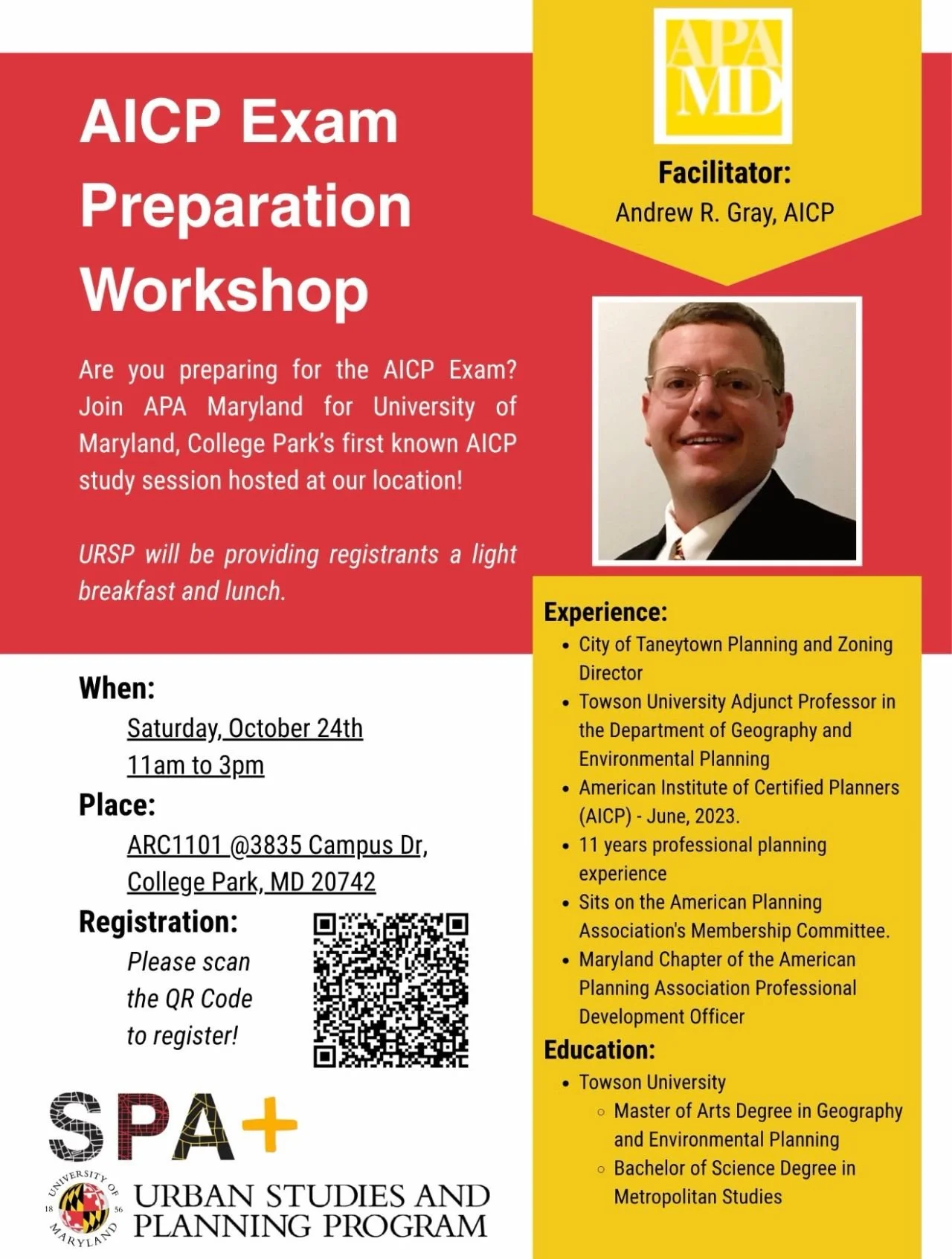
The Maryland Chapter of the American Planning Association and The University of Maryland, College Park are partnering to host an AICP Study Session, on Saturday, October 24, from 11 AM to 3 PM. Please join the Maryland Chapter’s Professional Development Officer (Andrew Gray, AICP) as he discusses the One Path process, preparing for the exam, and reviews/discusses exam-like questions.
More information regarding room location, registration, and lunch will be forthcoming (last updated 9/18/26)
Turf Valley Resort
Ellicott City, Maryland
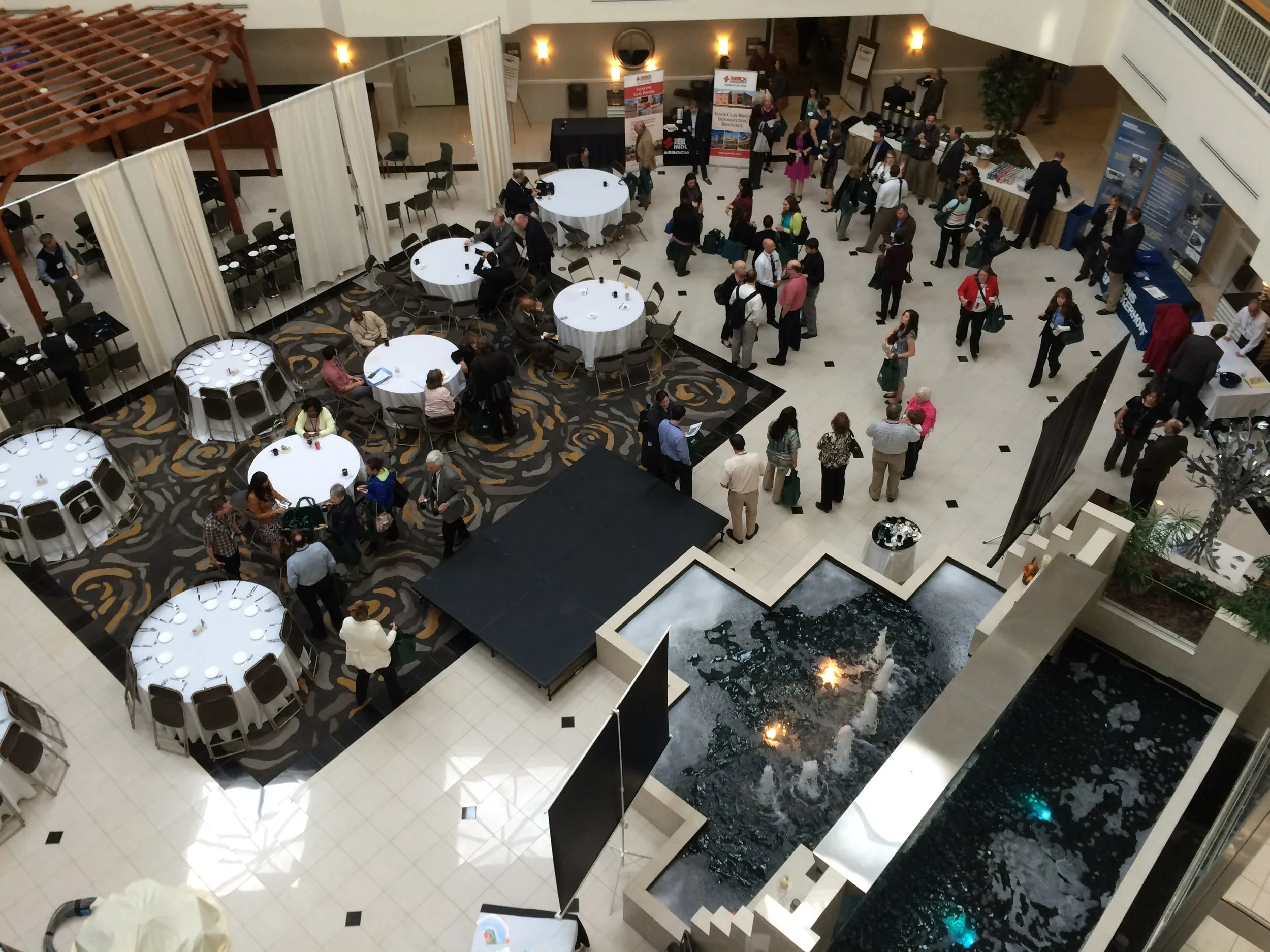
The Maryland Chapter of the American Planning Association is thrilled to announce the return of our Bi-Annual Conference! We are excited to head back to the site of our successful 2024 event: Turf Valley Resort.
This year’s conference theme is Planning at the Speed of Change.
As technology rapidly evolves, our communities face unprecedented transformations from data centers and autonomous vehicles to smart infrastructure and more. As planners, we must proactively address these ever-changing dynamics. Our goal this year is to bring together planning professionals from throughout the region to collaborate, share best practices, exchange proven strategies, and cultivate thoughtful approaches to planning for our shared future.
Big news for urban planners, architects, and book lovers!
The Booked on Planning Podcast is stepping out of the headphones and into the real world. Join us for our inaugural Booked on Planning Book Summit this fall!
Where: Graduate by Hilton (Charlottesville, VA)
When: October 12-13, 2026
Get ready for a day and a half packed with author presentations on recent urban literature, exclusive inside looks at the publishing process directly from publishers, a guided walking tour exploring the unique architectural and planning history of Charlottesville, and invaluable networking.
Secure your seat today!
Guest Host: APA Northern New England Chapter
Local Public Finance for Planners: You may know a little about how local governments raise and spend money, but do you realize how closely aligned it is to planning work? We'll go over the basics of local public finance and talk about what it matters for planners. We'll talk about how budgets get created, how money is appropriated, and what happens at the end of the fiscal year. We'll also talk about state and federal grant and aid programs, and look at fiscal tools like Tax Increment Financing from a planning perspective.CM 1.5
CM #TBA
Guest Host: APA Smart Cities Interest Group (SCIG) + APA Water & Planning Network (WPN)While data centers have been distinct land uses since at least the 1990s, their scale and speed of deployment have exploded in recent years due to cloud computing and the emergence of artificial intelligence (AI). This webinar will explore the multifaceted implications of data centers for local communities, focusing on environmental sustainability – particularly energy and water usage. Loudon County, VA Supervisor Mike Turner will cover lessons learned in the community with the largest concentration of data centers in the world, including developing trends in the data center landscape, possible future scenarios, and 15 best practices for local communities. Chris Dietz, Critical Infrastructure Analyst with the Idaho National Laboratory, will take a deeper dive into data center infrastructure requirements, impacts, and emerging technologies. Manny Patole, Assistant Professor at NYU’s Tandon Center for Urban Science and Progress, will conclude with thoughts on the broader implications of data centers and AI for planners and communities, including environmental justice and the role of technology in serving people. Links to a comprehensive set of resources on planning for data centers will be provided as part of the presentation.
CM 1.5
CM #TBA
Guest Host: APA Maryland
Our panel will discuss resiliency issues facing planners, tools available to planners, and how specific jurisdictions (Maryland, California, Maine, and Boston) are using those tools to tackle these issues.CM 1.5
The AASHTO Council on Active Transportation (CAT) and Committee on Planning (COP) will convene in Baltimore, Maryland, July 27–29, 2026. Held under the theme “Planning for a Safe, Active, and Multimodal Future,” the meeting will bring together state DOT professionals and partners to explore key issues at the intersection of transportation planning and active transportation.
Meeting Home - 2026 AASHTO Joint Council on Active Transportation and Committee on Planning Meeting
Agenda 516e73a1cd194269a64f7e2230c54263.pdf
Registration Information - 2026 AASHTO Joint Council on Active Transportation and Committee on Planning Meeting
CM #TBA
Guest Host: APA Urban Design & Preservation Division
Technology is reshaping how preservation professionals document, analyze, and plan for historic places. This webinar explores tools such as GIS, field data collection, mapping, and visualization to support preservation planning and adaptive reuse.Attendees will learn strategies for filling critical data gaps, building actionable datasets, and using technology to inform planning decisions. While digital tools improve efficiency, successful preservation still depends on community engagement, local knowledge, and strong partnerships.CM 1.5
July 17, 2026 | 1:00 - 2:30 PM ET
Guest Host: APA Pennsylvania Chapter
All three Levittowns in U.S. are the prototypical American post-WWII residential development. Do they have anything to teach us after 75 years of existence? This session will explore their impact on suburban development and mixed legacy over the last 8 decades. It will cover Levittown's history (including several riots), its positive and negative planning legacies, and its role as both a model for suburbia and a cautionary tale about car dependency, discrimination and racial intolerance. Levittown remains a living and evolving example of the American suburban landscape.
CM 1.5
CM #TBA
Guest Host: APA Private Practice Division
What does it mean for a street or trail to be sustainable and/or resilient? From design for drainage, material selection, to heat mitigation and maintenance regimes, many factors come into play. As climate impacts intensify and communities seek healthier, lower-carbon transportation options, practitioners are increasingly called to deliver infrastructure that performs under stress while supporting everyday mobility. The presentation will discuss sustainability and resilience in the context of multimodal transportation, with consideration for stormwater management, conversion of impervious to pervious surfaces, heat mitigation and trees, and user experience. It will highlight strategies and examples for applying guidance to real world infrastructure, including working across departments and developing consensus on treatments for constrained conditions.
CM 1.5
Guest Host: APA Community Engagement Interest Group
Hybrid engagement has moved from a pandemic workaround to a defining part of planning practice. Yet for many teams, it still feels fragmented, hard to evaluate, and unclear in impact. This webinar introduces the Designing Hybrid Engagement guide and translates its core framework into practical application. The guide presents hybrid engagement as a design challenge that requires intentionally connecting participation across time, place, and format to reduce barriers and strengthen outcomes. Participants will explore how engagement choices shape whose voices are heard, how input is interpreted, and how decisions are ultimately made. Drawing on real-world examples, the session highlights both successful approaches and common pitfalls, including “parallel track” engagement that separates in-person and online participation rather than connecting them.
CM 1.5
CM #TBA
Guest Host: APA Northern New England Chapter
The session focuses on the work done by ISO New England, the non-profit entity in charge of managing the power grid, the wholesale electricity markets and long-term transmission grid planning for New England, including the states of Connecticut, Maine, Massachusetts, New Hampshire, Rhode Island and Vermont. AICP members will gain a practitioner-level understanding of how ISO-NE plans for a reliable, regionwide electric system and how those planning functions intersect with land-use and community planning in the six New England states. The session will explain ISO New England’s three core roles and show how long-range transmission planning, load forecasting, resource adequacy, and stakeholder processes such as the Regional System Plan inform infrastructure investment and system resilience. Participants will learn how electricity reliability, cost, and the clean-energy transition intersect with local and regional planning decisions related to development patterns, housing, transportation, economic competitiveness, environmental goals, and equitable community outcomes. By the end of the session, planners will be better prepared to incorporate energy-system considerations into comprehensive planning, infrastructure coordination, and policy discussions, recognizing that energy is intrinsic to the economic, equity, and environmental issues they address every day.
CM 1.5
Maryland Department of Planning Sustainable Growth Webinar
"Setting the Stage for TOD" will show how Transit Oriented Development (TOD) can be encouraged and optimized through data, policy, and smart design. By exploring the methods and strategies used by planners, developers, and architects to prepare sites for TOD, this webinar will teach participants to compare existing station area sites that might support development, identify the institutional elements that support added density and livability, and recognize the physical components of a walkable, transit centered community.
Meagan Fairfield-Peak from the Maryland Department of Planning will demonstrate Maryland's Transit State Area Profile Tool and how it can be used to identify the strengths, needs, and possibilities for TOD sites.
Darron Cooper from the Maryland Department of Transportation will present how zoning, infrastructure, and transportation policy can benefit TOD and enable it to reach its potential.
Cecily Bedwell from Design Collective will present how developments centered around transit can be designed to create a strong sense of place and positively impact communities.
Brooks Phelps from MDP will focus on Transportation strategies and policies.
Following the webinar, attendees will be able to… Recognize the physical components of a livable, transit-oriented development site. Identify the elements that support a walkable, transit centered community. Compare existing station area sites that might support transit-oriented development.
1.5 AICP credits are available for this webinar and accommodations are available upon request. Please email joseph.griffiths@maryland.gov with any accommodation needs.
June 18, 2026 | 1:00 - 2:30 PM ET *Thursday*
CM #TBA
Guest Host: APA County Planning Division
Recent federal accessibility updates have elevated the importance of compliance with the Web Content Accessibility Guidelines (WCAG) 2.1, Level AA for counties and local governments. These standards apply to a wide range of public‑facing digital materials, including websites, online documents, multimedia content, mobile applications, and social media platforms used to deliver government services. This webinar will provide planners and local government professionals with an overview of WCAG 2.1 Level AA, clarify what types of digital content are covered, and examine how accessibility requirements intersect with planning, communications, and public‑facing service delivery. Drawing on coordination with the National Association of Counties (NACo), the session will also explore implementation considerations, emerging best practices, and the evolving legal and policy context shaping accessibility expectations for counties. The webinar is intended to support informed decision‑making and professional understanding of accessibility requirements relevant to planning practice.
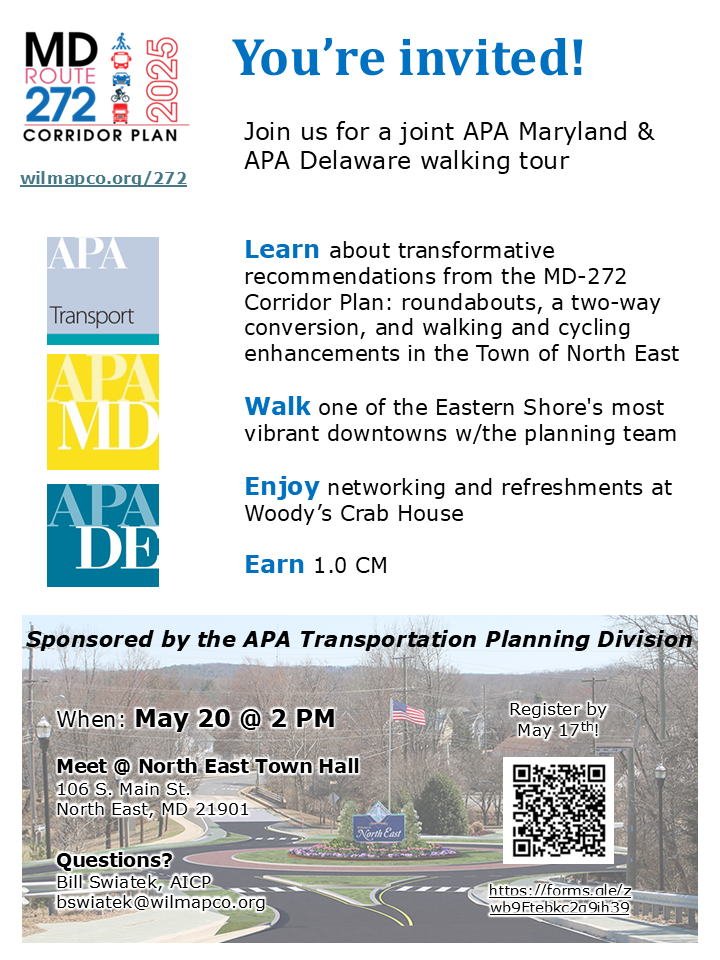
Join us for a joint APA Maryland Chapter / APA Delaware Chapter site visit and networking event focused on the MD-272 Corridor Plan.
Participants will learn about key elements of this transportation plan in downtown North East, including:
Converting Maudlin Avenue from one-way to two-way traffic
Installing two roundabouts
Identifying pedestrian and bicycle improvements
The plan’s robust public engagement process
The committee working to advance implementation
And more
Following the presentation, participants will walk through downtown to visit the streets and intersections identified for improvement and discuss the proposed changes in greater detail with planners and Town staff. The event will conclude with networking at Woody’s Crab House.
Session speakers:
Wayne Martin, PE, Senior Project Manager
Wallace Montgomery
Bill Swiatek, AICP, Principal Planner
Wilmington Area Planning Council
Betsy Vennell, Director of Planning
Town of North East
Grant Handley, Assistant Town Administrator
Town of North East
Questions? Email: Bill Swiatek, AICP (bswiatek@wilmapco.org)
CM #TBA | 1.5 CM Credits
Guest Host: APA Ohio
Access to city or neighborhood-level data is essential for refining public health strategies, but communities feel stuck relying on state- and county-level data to understand what’s happening locally. In this webinar, you'll learn how to access more granular data via the City Health Dashboard and Congressional District Health Dashboard, two freely available and interactive websites that provide data on over 40 measures of health and the factors that shape health, including Frequent Mental Distress, Broadband Connection, Air Pollution, and more. Participants will also learn how to use visualizations—like engaging metric maps—to identify, connect, and tackle neighborhood challenges. With this information, planners can foster meaningful community dialogue, support informed decision-making, and design health‑focused interventions that address the needs of the residents they serve. Learning objectives include: accessing and leveraging local-level data through the City and Congressional District Health Dashboards; utilizing Dashboard technical assistance; and learning how other communities have used Dashboard data to strengthen community health and well-being.CM 1.5
CM #TBA | 1.5 CM Credits
Guest Host: LGBTQ & Planning Division
How can planners and downtown leaders cultivate Main Streets where LGBTQIA+ people feel visible, welcome, and celebrated? Join the APA LGBTQ & Planning Division for a panel conversation featuring practitioners from communities across the country who are advancing inclusive downtown initiatives through programming, partnerships, placemaking, and storytelling.
Are you preparing to take the AICP Exam this year? Join APA Maryland for an in-person study session designed to help you feel confident and prepared!
📅 Date: Saturday, March 21, 2026
⏰ Time: 10:00 AM – 2:00 PM
📍 Location: Morgan State University, Center for the Built Environment and Infrastructure Studies (CBEIS)
📌 Who Can Attend? APA Members and APA Maryland Chapter Members
This interactive session will cover key exam topics, test-taking strategies, and insights from our Professional Development Officer (PDO) who is an AICP Certified Planner. Not an APA member yet? Students can join APA for free and take advantage of this valuable study session!
Got questions? Reach out to us at contact@apamaryland.org. We look forward to helping you achieve AICP certification.
Special Notes: A light lunch will be provided. Please feel free to bring snacks and/or lunch that best suits your dietary needs. More information about meeting room, parking, and what to expect the day of will be provided to registrants.
Find more AICP Resources Here: https://apamaryland.org/professional-development
Guest Host: APA Water & Planning Network
The Colorado Water Plan is a statewide planning document created first by legislation, and then refined through years of robust stakeholder input and complex modeling to provide a data-driven understanding of our current water supply and potential future scenarios. This plan highlights Colorado’s water vision, assigns work to the Colorado Water Conservation Board (CWCB) and its sister state agencies, and provides a framework for the critical efforts requiring collaboration from partners across the state. The 10-year schedule set forth in the Water Plan allows time to work on these important issues while setting a deadline for its update before it becomes outdated. The CWCB leads this collaborative action through guiding principles, funding, and technical support, but cannot do the work alone. This webinar will open with a summary of water and land use planning requirements in the 50 states, and will then feature presentations explaining how the Colorado Water Plan is organized and implemented from the state level to the boots-on-the-ground partners, resulting in a statewide cooperative effort -- developed over many years -- to both develop and conserve water resources.
Title: Land Use Decisions for Healthy Landscapes
Date/time: Thursday March 12, 2026 12pm - 1:30pm
Speakers:
Peter Claggett, USGS
Jeff Lerner, EPA
Jackie Pickford, USGS
Description: The well-being of the Chesapeake Bay depends on the health of the lands that make up its watershed. As communities within the region continue to grow or intensify their activities, the demand for land and resources can add pollutants to the system and put our waters and habitats at risk. Many of these lands support not only water quality but also provide other economic, recreational, cultural and ecological benefits we do not want to lose. That's why the Chesapeake Bay Watershed Agreement was recently updated with a revised Healthy Landscapes goal and outcome related to land use planning. Come hear what planners should know about these changes, how your community can be involved and what new or updated data and tools are available to support your communities goals and future planning.
Learn essential skills, connect with experienced planners, and build a supportive network of your fellow planning students.
This Month’s Topic: Policy & Advocacy

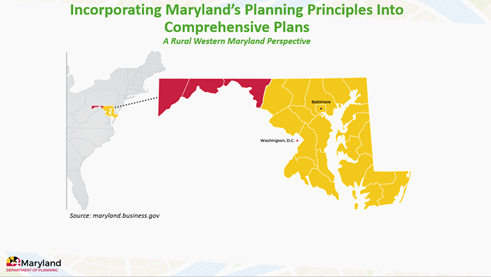
The Maryland Department of Planning (MDP) is presenting the webinar, “Incorporating Maryland's Planning Principles into Comprehensive Plans: A Rural Western Maryland Perspective". Panelists will present various perspectives and insights concerning the incorporation of the Planning Principles into local comprehensive plans. The webinar will address MDP’s Technical Advisory Group (TAG) process, along with insight from panelists; each in different phases of their comprehensive plan development processes, including early-development, late-development, and implementation. MDP will be joined by planning partners from Garrett County Planning and Zoning, the City of Cumberland/ Calvert County Planning and Zoning, and Smith Planning & Design.
Following the webinar, attendees will be able to ….
Explain each Planning Principle to staff members, community members, planning colleagues, etc.
Recognize the importance of the inclusion of the Planning Principles in their respective jurisdiction’s planning efforts/documents.
Effectively compose and revise comprehensive plans, with the intent of ensuring their jurisdiction’s plan incorporates the Planning Principles.
Apply the planning principles through their daily work via sound planning practices.
Measure progress toward successful planning principles implementation using MDP’s Sustainable Growth Implementation Guide.
Virtual Event: https://smartgrowthamerica.org/equity-summit/
Welcome to the website of the Maryland Chapter of the American Planning Association. Our mission is to make great communities happen in Maryland by offering continuing professional development and other valuable services to our members that will enable them to excel in their practice. We advocate for excellence in planning, promoting education and citizen empowerment, and providing our members with the tools and support necessary to meet the challenges of growth and change. We hold a biennial conference, produce a monthly newsletter, offer continuous opportunities to network, and provide new and varied educational opportunities across the state.
Thank you to our Sponsors!
Silver

Bronze

Ruby


Sapphire


Wye Oak
Redbud
Black-eyed Susan

Powered by Squarespace.