
Call for 2026 Maryland Planning Award Nominations
It’s time to celebrate the outstanding planning work happening across Maryland. The Maryland Chapter of the American Planning Association (APA MD) and the Maryland Planning Commissioners Association (MPCA) invite you to submit nominations for the 2026 Maryland Planning Awards.
Awards will be presented on the evening of Monday, October 19, 2026, during the 2026 Maryland State Planning Conference at the Turf Valley Resort in Ellicott City, MD. We encourage everyone involved in planning and sustainable development to attend and to recognize the achievements of their peers.
Who Should Be Nominated?
Do you know an individual or team making a difference? Consider nominating:
Professional planners
Citizen planners
Engaged community members
Entire staff teams
Planning boards or commissions (Planning Commission, Board of Zoning Appeals, Historic District Commission)
Maryland’s planning community contributes countless hours to improving our communities. Help ensure their work gets the recognition it deserves.
How to Submit a Nomination
Click the link below to access the APA MD 2026 Awards Nomination Form, and please upload all supporting documentation to https://www.dropbox.com/request/mt72tdzx7gizff6e0eqv. Be sure to include the name of the nominee in the filename of each uploaded document.
Supporting documents can include plans, documents with links to websites, images, or anything that conveys more about the nomination beyond the text submitted in the form itself.
All nominations must be submitted via the online form (above). There is no fee to submit a nomination. For questions about eligibility, please contact:
Joe Griffiths, Awards Committee Chair
joseph.griffiths@maryland.gov
Key Dates
July 31 – Nominations deadline
Mid-September – Winners notified
October 19 – Awards ceremony
2026 AWARD CATEGORIES AND DESCRIPTIONS
Eligibility: The Maryland Planning Awards recognize outstanding planning work for projects or programs in Maryland for both groups and individuals, as well as professional, student, and citizen planners. All submissions other than those for Career Achievement must be for projects or plans completed in Maryland in 2025 - 2026. Plans must have been formally adopted by a Maryland jurisdiction to be considered eligible. Nominations are deemed eligible if they meet the descriptions listed below for each award category. For all awards, the nominee - or at least one member of the project or planning team - must either be a member of the American Planning Association and the Maryland Chapter, a currently enrolled or recently graduated student in a university planning program, an appointed member of a planning board in Maryland, or a citizen actively involved in planning in their community. The bullet points under the category descriptions below indicate the characteristics of exceptional submissions, which the Awards Committee will consider in addition to the scoring standards detailed in the rubric. The rubric will be used to score submissions in every applicable scoring category. A submission is eligible for only one award category.
Notice for Firms Outside of APA Maryland’s Jurisdiction: The Awards Committee has decided to accept nominations for all work performed in the State of Maryland by in-state and out-of-state consultants. The Committee will not consider nominations by Maryland firms for work performed outside of Maryland.
-
This award recognizes a plan, project, program, process, report, or ordinance that demonstrates the crucial connection between housing, transportation and land use. This category acknowledges the 2026 American Planning Association Policy Priorities.
The connection is clear and deliberate
Cross disciplinary coordination, planning, and decision making
-
This award recognizes a project, plan, or paper completed by a planning student or group of students.
Supplements the work of professional planners
Addresses real world, practical needs of the planning profession
-
This award honors a planner who has devoted his/her career to the planning profession and who has retired within the past two years or is nearing retirement.
Career demonstrates measurable impact on the built environment, community quality of life, and the planning profession
The submission includes statements from other planners describing the nominee’s impact
-
The award recognizes a community engagement process that creatively and comprehensively involves stakeholders, particularly underrepresented groups. Beyond engagement, efforts deserving recognition in this category should demonstrate how community input was used to develop responsive and representative plans or projects.
Resources dedicated to intentionally engage and empower underserved communities in plan development
Efforts are more targeted than engaging “everyone”
-
This award recognizes an exemplary comprehensive or sub-area plan advancing healthy, sustainable, resilient, and equitable communities. The plan demonstrates complex analysis, broad stakeholder engagement, creative and leading-edge strategic thought, and mechanisms for plan implementation, assessment, accountability, and adjustment. There will be one plan awarded for jurisdictions with populations over 10,000 and another for jurisdictions below 10,000.
See exceptional column in scoring rubric for explanation of expectations
Plans fully address the interconnectedness of planning areas and concepts and integrate the planning process from historical analysis through implementation measurement
-
This award recognizes efforts demonstrating e progress in plan implementation highlighting measurable achievement of plan objectives, including ordinance rewrites, capital funding, significant infrastructure (gray or green) projects, redevelopments, etc. Submissions must reference planning documents, but planning documents alone are ineligible.
Explain how the implementation measures are consistent with a comprehensive or master plan
Measurable outcomes, not just measurable outputs
Statements or testimony from stakeholders highlighting improved conditions or quality of life
-
This award recognizes planning boards, boards of zoning appeals, historic preservation committees, or individual members of such boards for their contribution to sustainable communities, plan development and implementation, leadership, or capacity building.
Highlight the coordination between citizen and professional planners
Engage residents and other stakeholders in the planning and implementation process
Questions + Scoring Rubric
Please submit nominations using the online form. The form asks nominators to respond to the following prompts
Inclusivity and Equity: Explain how the planning effort or product of the nominee has demonstrated inclusivity and equity by both ensuring inclusivity and responding to feedback in a manner in which the residents and stakeholders served as co-creators of the final product.
Sustainability: Explain how the planning effort or product of the nominee holistically incorporates all factors that advance more sustainable communities.
Innovativeness: Explain how the planning effort or product of the nominee demonstrates and executes leading edge planning best practices.
Impact and Metrics: 1) What impact has the planning effort demonstrated, and 2) How is the impact measured?
Work Quality: Explain how the planning effort or product of the nominee illustrates an engaging (visually and/or communicatively), informed, well-considered, thoroughly analyzed, and superior product.
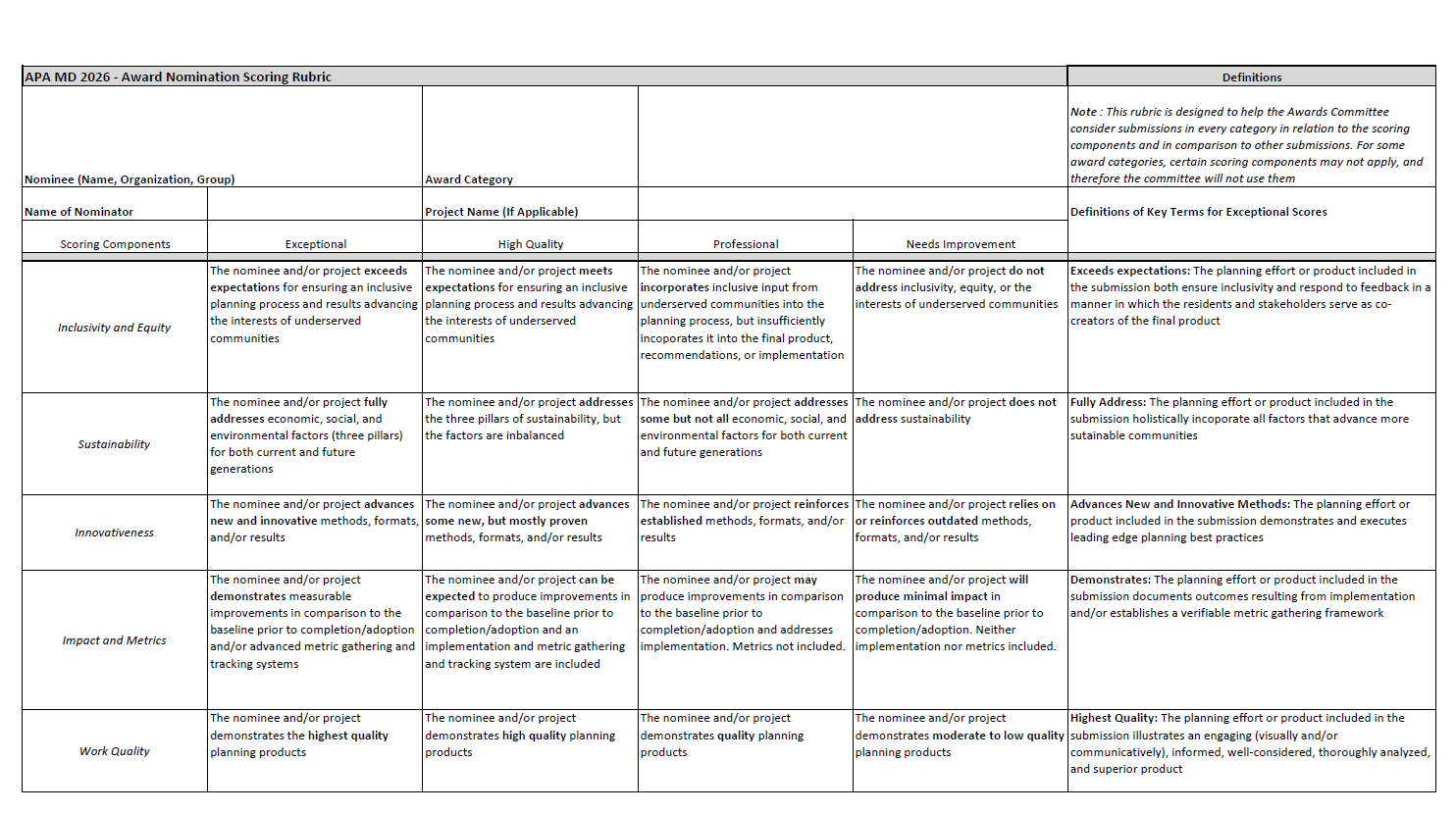
Click on Rubric Above to view and download PDF.